|
| Facts |
|
Woodarc Doesn't Just Grow on Trees
Woodarc 's unique look comes from a very particular process that begins with top quality Rubber & Beech logs. Grown in managed forests, these special woods are harvested, peeled, and clipped into leaves of veneer. The leaves are then stacked and dried, readying them for dyeing.
Woodarc gains remarkable color consistency from precise dyeing, which requires time,a carefully controlled pressure level, and an exact temperature. This system allows the dye to completely penetrate the leaves, giving the lumber consistent color throughout.
The dyed leaves are assembled into stacks with adhesive before undergoing a sophisticated lamination process in a high-pressure press. When they emerge, the colorful blocks of Woodarc are milled into 1 to 2 inch thicknesses, and are prepared for distribution nationwide. |
|
| Basic Use |
|
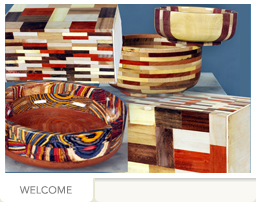
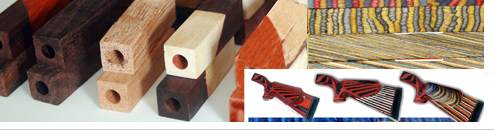
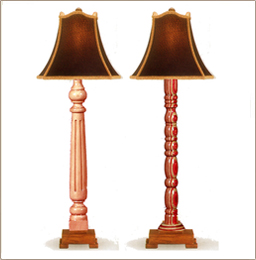
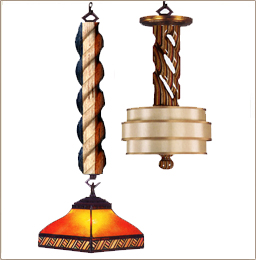
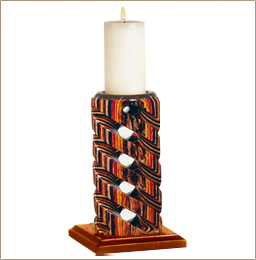
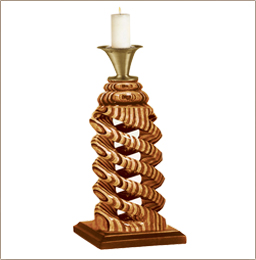
| WOODARC lumber is a decorative wood product that can be turned, shaped or sculpted. Artisans can use WOODARC to create an unlimited number of unique items such as: bowls, pens, handles, drawer and pull components, musical instruments, clocks, and picture frames. |
|
| Composition |
|
WOODARC is produced by first selecting high quality Rubber & Beech logs from managed forests in Africa. Once harvested, the trees are rotary peeled and clipped into 25'' veneer leaves. They are then dried and stacked in preparation for dyeing.
Dyeing is the key to the remarkable color consistency in WOODARC. The stacked veneers are submerged in a heated, pressurized vat which contains a water soluble dye. Once the dye has completely penetrated the veneer leaves, they are removed and dried. The veneer is now ready for gluing.
Adhesive is layered between each leaf of veneer to create a stack. The stack is then laminated in a high pressure press to form a large rectangular block. The block is then sawn into slabs of WOODARC lumber. |
|
| Usage and Limitations |
|
| Surface |
| Preparation |
|
| Use proper safety precautions such as eye and respiratory protection prior to working with WOODARC lumber. We recommend sharp tools and a dust collection system. |
|
| Finishing |
|
| WOODARC lumber can be stained and should be finished. The finishing steps required are similar to conventional lumber. First, sand the surface of WOODARC to achieve a smooth surface. Second, depending on the final finish, apply sealer coats. Finally, apply the top coats using standard wood finishes such as oil, lacquer, varnish, or urethane. Follow the finish manufacturer's instructions. Please refer to the limitations section of this sheet. |
|
| Maintenance |
|
| Because a top coat is required, the final surface must be cleaned and maintained in accordance with the recommendation of the finishing manufacturer. |
|
| Storage and Handling |
|
| Rough-cut or machine WOODARC soon after receiving it (especially larger/thicker pieces). Rough-cut pieces should be acclimated at least 48 hours prior to final machining and finishing. WOODARC not used within 48 hours must be wrapped in plastic to maintain moisture content. WOODARC should be stored in a completely supported flat position. |
|
| Limitations |
|
Store according to the instructions above. WOODARC is not recommended for exterior use. Pigments are sensitive to ultraviolet light, and all woods will fade or change color with prolonged exposure to light. Certain pigments, such as pastel colors, are more sensitive to light and extra care must be used to protect them from UV exposure. A UV inhibiting finish is recommended.
WOODARC lumber is not inert. It is sensitive to ambient atmosphere conditions such as temperature and moisture. It is essential that WOODARC be properly acclimated to atmospheric conditions prior to use.
Because WOODARC is a lamination, it cannot be dried conventionally. THEREFORE, WE DO NOT WARRANTY AGAINST CUPPING, WARPING, OR SPLITTING. Particularly with thicker pieces, we do not recommend long term storage. After WOODARC has acclimated, use it as soon as possible. |
|